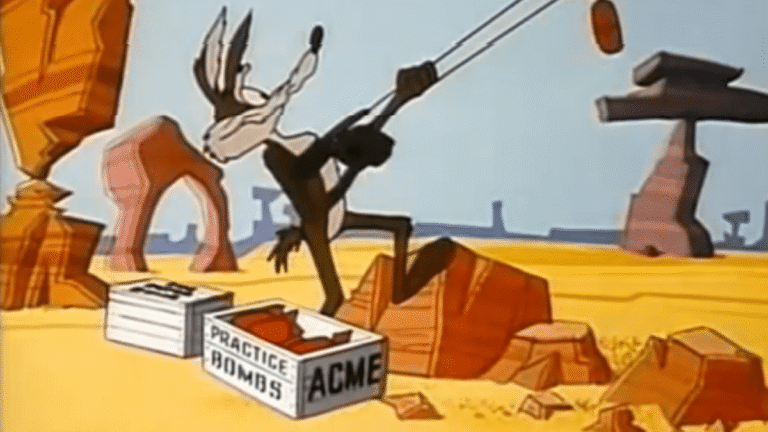
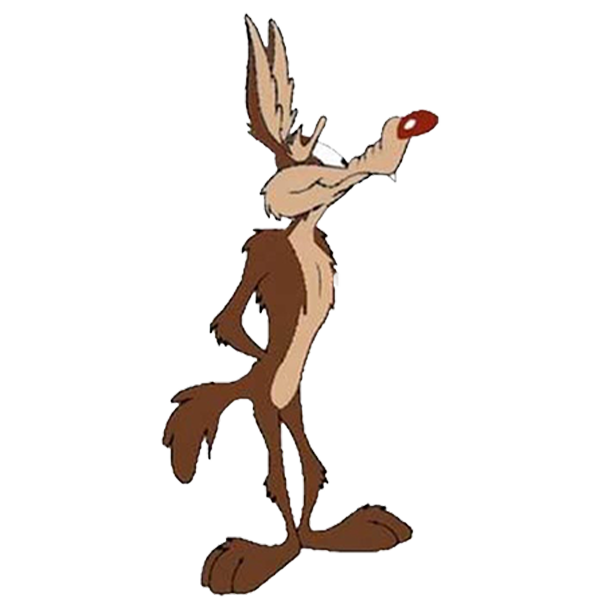
"Allow me to introduce myself. My name is Wile E. Coyote, genius."
(Operation: Rabbit, 1952)
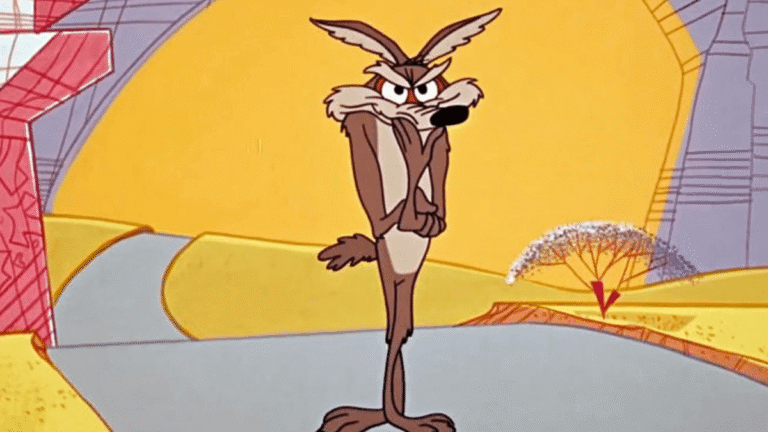
Wile E. Coyote is the most determined failure in animation. He is hungry, inventive and absolutely certain that the next Acme product will finally deliver the Road Runner. It never does. Chuck Jones made the Coyote the real protagonist of the chase: the audience watches his plans, his hopes and his falls, and roots for him even while laughing at him. In the Road Runner shorts he never speaks; his face, his posture and a few hand-lettered signs say everything.
| Species: | Coyote |
|---|---|
| First appearance: | Fast and Furry-ous (1949) |
| Created by: | Chuck Jones (director) and Michael Maltese (writer) |
| Original voice: | Silent in the Road Runner shorts; Mel Blanc in his speaking roles, starting with Operation: Rabbit (1952) |
| Signature lines: | "Wile E. Coyote, genius." |
| Frequent co-stars: | Road Runner, Bugs Bunny |
Jones and Michael Maltese created the Coyote alongside the Road Runner, and both debuted in Fast and Furry-ous in 1949. Jones often cited Mark Twain’s description of the coyote in Roughing It as an inspiration for the scrawny, perpetually starving character.
In Operation: Rabbit (1952) the Coyote stepped out of the desert chase and spoke for the first time, introducing himself to Bugs Bunny as a self-declared genius. That suave, overconfident voice gave Jones a second version of the character to use against Bugs, while the silent Coyote of the Road Runner shorts kept chasing for decades.
The Coyote’s pride is what dooms him. He never questions the plan, only its execution, and he keeps buying from Acme despite every catastrophe.
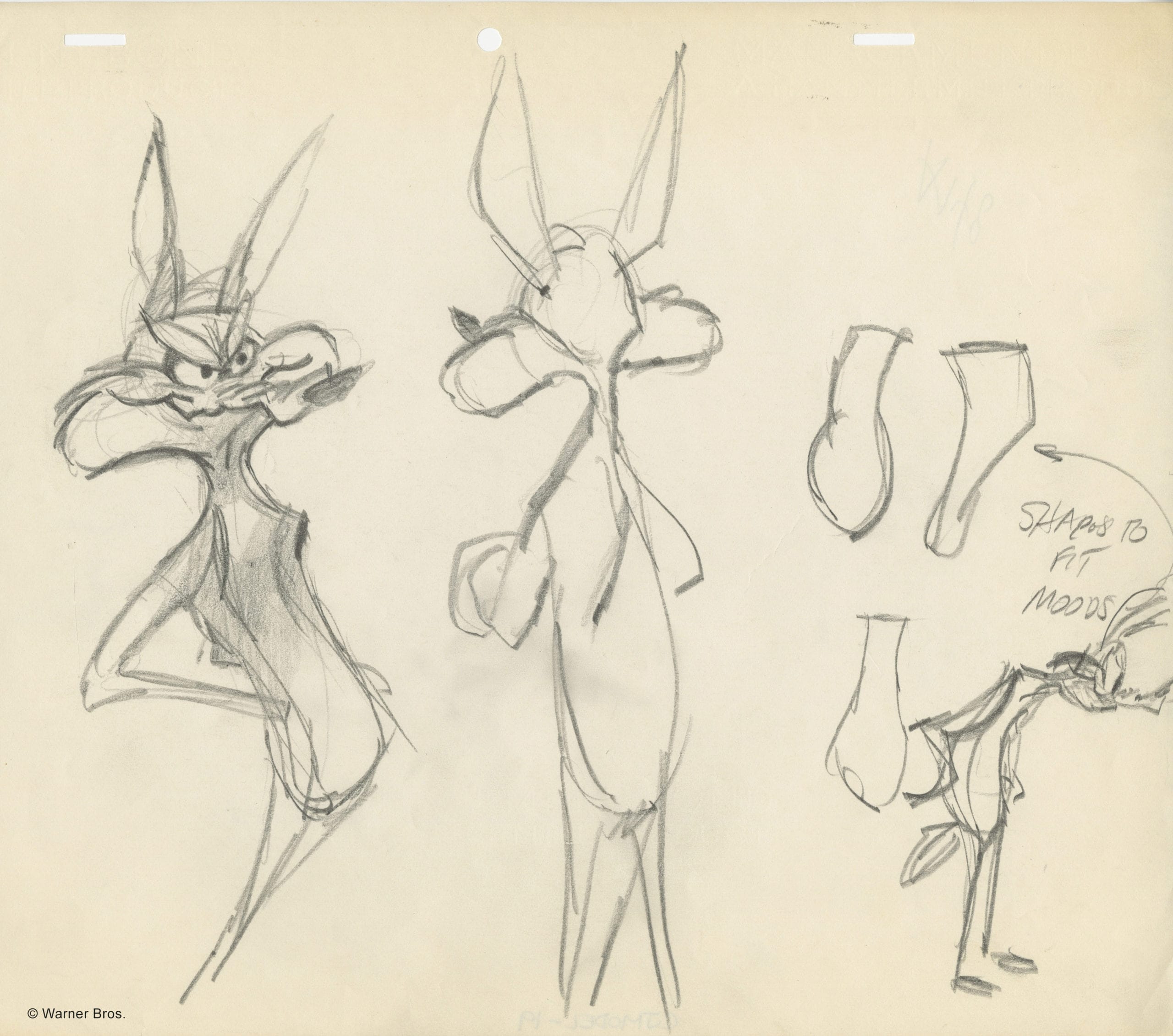
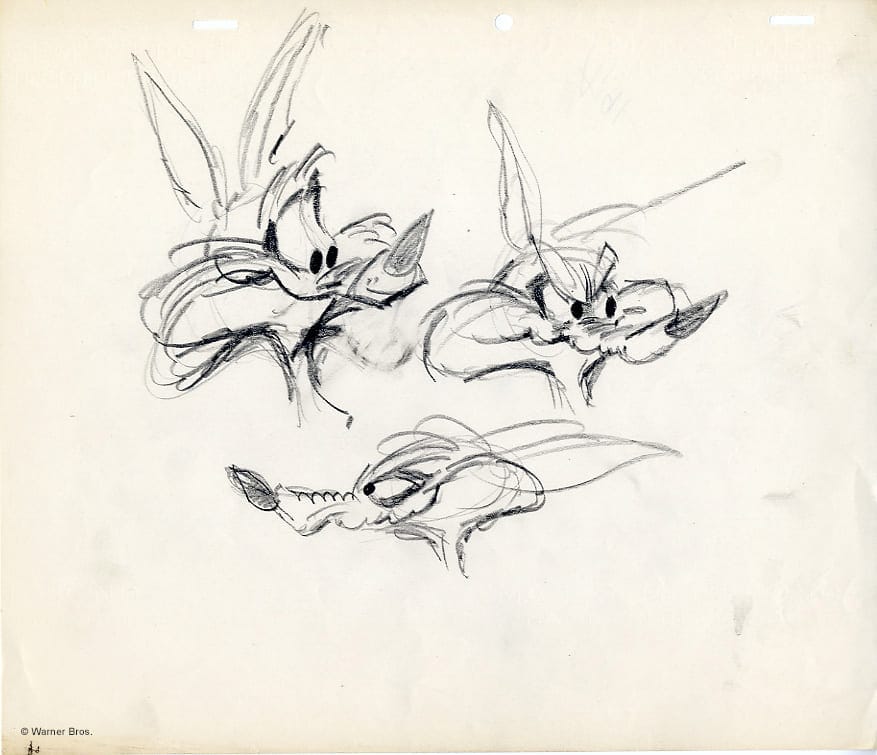
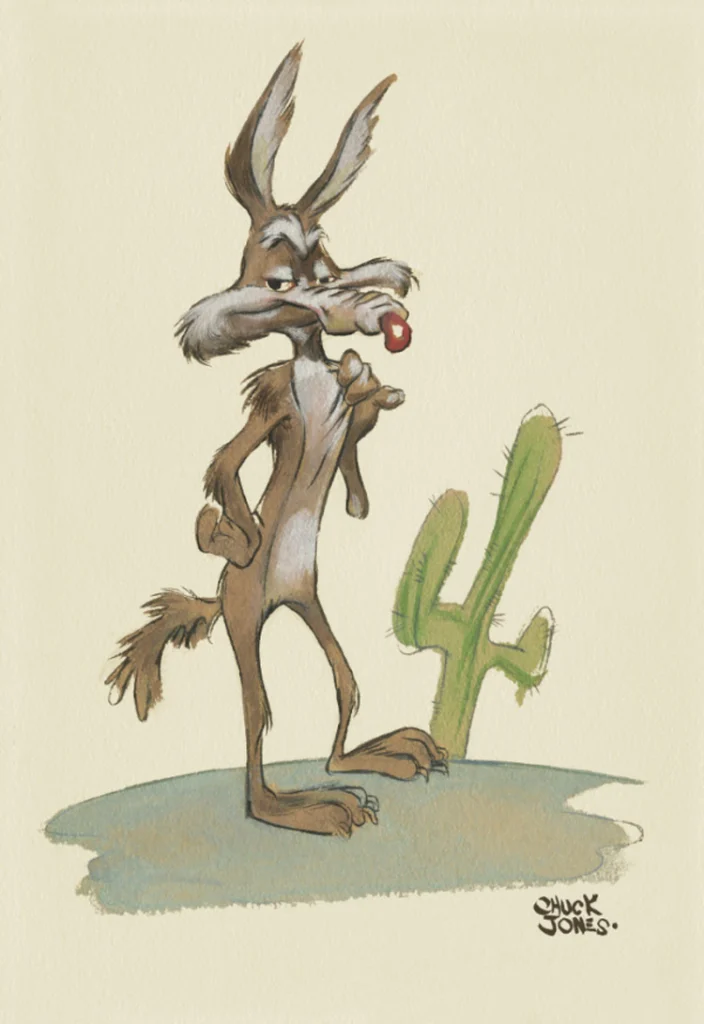
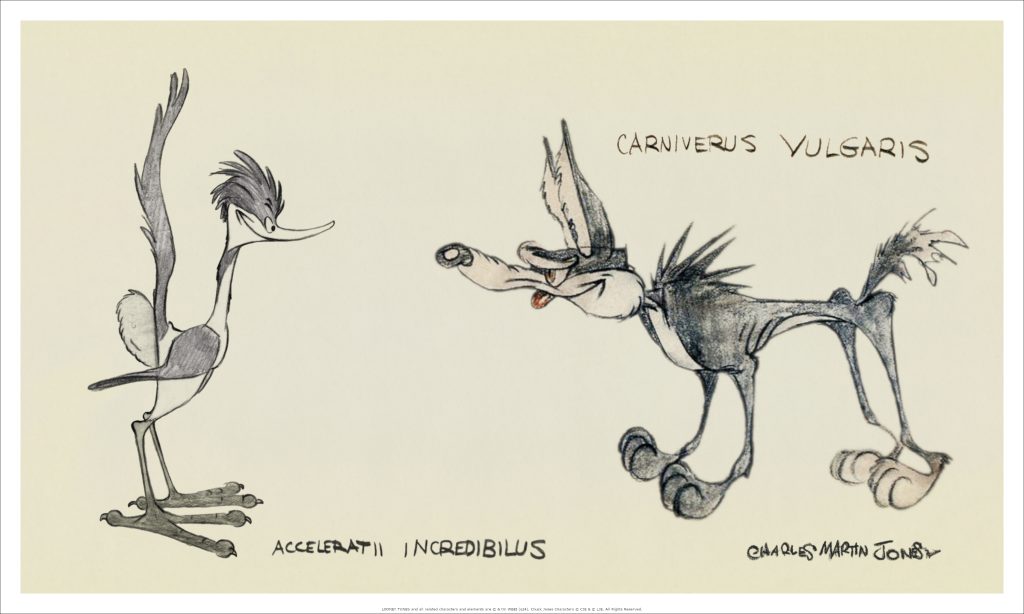
Jones’s notes describe the Coyote as elegant but awkwardly built. He shares Bugs Bunny’s skull shape, with prouder cheeks, slightly broken ears and bonier limbs. A small pot belly completes the hungry look. In later cartoons Jones often set one knee higher than the other and added an extra toenail. Fur appears only where it bends over a joint or a curve of the face, which makes him look ragged. Jones based the tail on Japanese paintings of stormy seas, turning the usual soft curve into a sharp, hostile one.
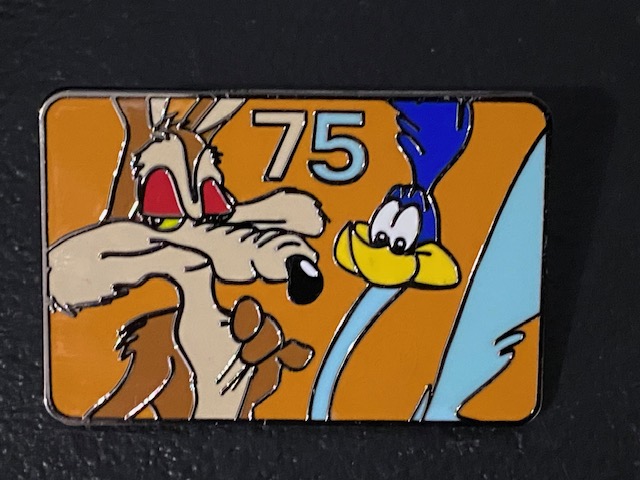
The chase has run for more than 75 years since 1949, and the Coyote’s Acme catalog became a cultural shorthand for gadgets that backfire. His design also lives on in Ralph Wolf, Jones’s near-twin for the sheepdog cartoons. Later voices for the speaking Coyote include Joe Alaskey, Maurice LaMarche, James Arnold Taylor, J. P. Karliak and Eric Bauza.
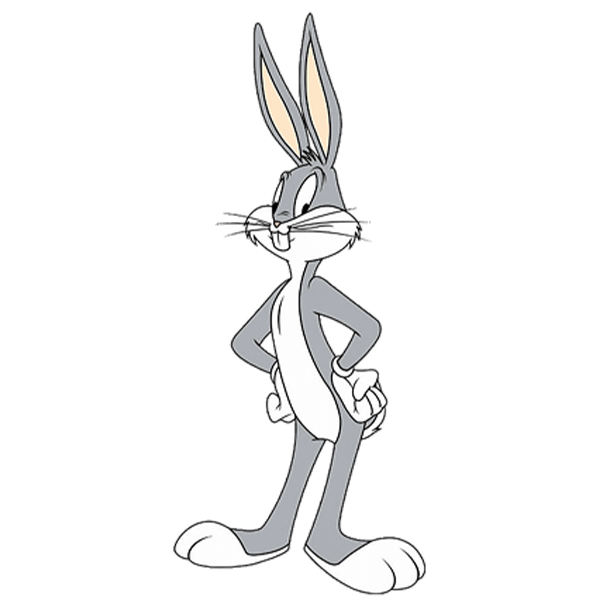
The coyote is quite an elegant character, but because of his build he has a problem conveying what he feels he is. In silhouette he looks like a dissolute Bugs. His arms and legs are much bonier than Bugs’s (when people are skinny, their elbows and shoulders look bigger), but their body shape is the same. The two characters have identical skulls, but the Coyote’s cheeks stand absurdly proud, whereas Bugs’s are confidently contained. Even the ears are similar, with the difference that the Coyote’s are a little bit broken. Wile E.’s hungry look is completed by a little pot belly.
The main change in the way I drew the Coyote over the years involved the knees. When he comes to a stop in the later films, one knee is a little higher than the other, adding to his ragged look. These knees and the pot belly are usually enough to identify the Coyote. And I usually give him an extra toenail (I like to leave one hanging out.) The way I draw the Coyote’s fur adds to the unkempt impression. The fur is shown not over all the body but only where it changes direction over a joint or a curve in the face. Fur is not obedient to the body; it will cling only as long as the surface remains fairly flat. The Coyote’s hair is perfectly willing to cling to the upper part of his cheek, but it peels off in the break, just as it does on Bugs Bunny’s face. In the same way, excess flesh creases in the folds of a heavy animal’s body.
The ragged tail was inspired by Japanese paintings of stormy oceans. When the Japanese artist wants to make a breaking wave frightening, he draws it like hostile claws rather than in the softer Western way. If you have a boat hanging on top of a wave in a Japanese painting, you know it’s going to go over. These are waves to die on, not to surf on. The normal way to draw the tail of any animal, from a squirrel to a dog, is to make it round and soft like the Western waves; reversing this created the Coyote’s tail. It is the difference between concave curves and convex curves, between the cuddly and the ratty.

– Chuck Jones
Every piece in our Wile E. Coyote collection is certified by the Chuck Jones family. Browse originals, limited editions and prints below, or contact our art consultants with any questions.
$495.00 – $795.00Price range: $495.00 through $795.00